


Corrosion protection for piston rods and tubes: hard chrome, nickel-chrome or a stainless base
Hard chrome, a nickel-chrome coating or a stainless base: what the salt-spray rating means, how the three protections differ, and which product suits which environment.
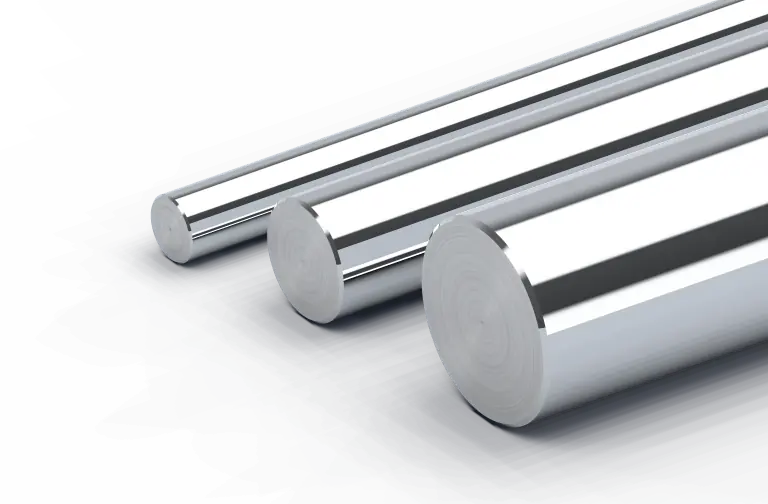
At a glance
Corrosion protection on a piston rod or tube comes from the coating and the base material. The catalogue offers three routes: hard chrome on carbon or alloy steel, a nickel-chrome coating, and hard chrome on stainless steel. Below is what the corrosion data means and which product suits which environment.
- Hard chrome
- Rating 9–10 after 200 h NSS in Max Metal's data
- Nickel-chrome
- A nickel layer with hard chrome on top
- Stainless base
- Stainless steel with hard chrome
- Salt spray
- A quality check, not a service-life forecast
What the salt-spray rating means
For the hard chrome-plated bars and tubes, Max Metal's product data states a rating of 9–10 after 200 hours of neutral salt spray (NSS) to ISO 10289.
Neutral salt spray is one of three tests in ISO 9227; the other two use acetic acid (AASS) and copper with acetic acid (CASS). ISO 10289 is the method used to rate the specimen after the test: a higher number means less corrosion, and 10 is the best figure in makers' catalogues.
ISO 9227 states that these tests are not meant for ranking different materials or for predicting their long-term corrosion resistance. So 200 hours in the chamber is not a service life.
Hours from different tests are not directly comparable. Ovako states that a given degree of corrosion is reached 2–3 times faster in AASS than in NSS, and across makers' catalogues the same rating 9 follows different tests and different hours.
Three protections and how they differ
- Hard chrome on carbon or alloy steel. For harsher conditions, Ovako offers multi-layer systems: double chrome and nickel under the chrome.
- Nickel-chrome. As Ovako describes it, the steel first gets a corrosion-resistant nickel layer, then an outer layer of hard chrome. Ovako recommends it for aggressive environments: high salinity, humidity and polluted air, rods that stay extended for long periods, mining, offshore and chemical plants.
- A stainless base with hard chrome: see the stainless chrome-plated bars. The difference between the two steel grades is in the next section.
Type 304 or 316: the difference in the steel
Steel 1.4301 (type 304) is the basic chromium-nickel austenitic stainless steel. Aperam states good corrosion resistance, including against pitting and crevice corrosion; no molybdenum is listed in its typical composition.
Type 316 steels contain molybdenum. For 316L (1.4404) Aperam gives about 2 % molybdenum and very good resistance in acidic and chloride-containing environments; listed uses include naval engineering, food, chemicals, and oil and gas.
Outokumpu places 304 in its range for corrosive environments and 316L in its range for highly corrosive environments.
The stainless chrome-plated bars in the product data are type 304 or 316, without the L. If you need 316L, contact us.
The three protections compared
| Item | Hard chrome | Nickel-chrome | Stainless base |
|---|---|---|---|
| Base and coating | Carbon or alloy steel with hard chrome | Carbon or alloy steel with a nickel-chrome coating | Stainless steel with hard chrome |
| Published test | Yes, see the salt-spray section | No published figure: contact us | No published figure: contact us |
| Forms in the catalogue | Bars and tubes | Bars and tubes | Bars only |
| Environment | Hydraulic and pneumatic cylinders (product pages) | Corrosive environments (product pages); offshore, marine, mining and more (chrome bar and tube family descriptions) | Corrosive environments, marine and offshore, food and pharma (product page) |
Which product for which environment
- A hydraulic or pneumatic cylinder: a hard chrome-plated bar; for a piston, an externally chrome-plated tube.
- Marine and offshore: nickel-chrome bars and tubes (per the chrome bar and tube family descriptions), or a stainless chrome-plated bar.
- Food and pharma: a stainless chrome-plated bar. The data has no stainless tube: contact us.
- Corrosion and heavy loads together: induction-hardened nickel-chrome bars or tubes.
Bars and tubes for corrosive environments
Sizes, grades and coatings are on each product page.


Induction-hardened nickel-chrome plated bars
Induction-hardened bar with a nickel-chrome coating.
→ View detailsInduction-hardened nickel-chrome plated tubes
Induction-hardened tube with a nickel-chrome coating.
→ View details

Catalogues and files
Questions about corrosion protection
Which standards describe engineering chrome and nickel coatings?
Hard chromium for engineering purposes is covered by ISO 6158, and engineering nickel by ISO 4526. ISO 1456 is for decorative nickel and nickel-chromium coatings and is not the reference for piston rods. Max Metal's product data does not name a coating standard.
How thick is the chrome layer on piston rods?
Makers state at least 20 µm (15 µm for the smallest diameters); some give 20–30, 25 or 25–35 µm. The value for each Max Metal product is on its product page.
Send the environment, dimensions and quantity for a quotation.
Need a quote for your next project?